

How to Help Your Neighbors in Need.
Food scarcity, stress, and support in trying times.

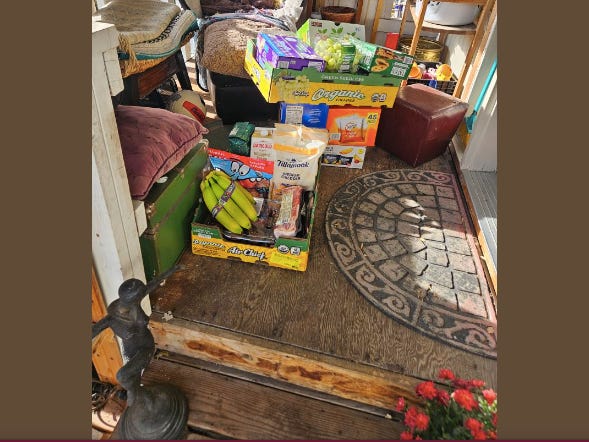
Someone I know, a neighbor from another state, sent us this grocery delivery last week. I wish this kind of abundance for everyone, but especially for anyone who is worried or struggling.
A dear person sent us this grocery delivery knowing I care for kids, knowing SNAP has been cut. I do not fear because my connection to source always provides for me, for us.
I pray that people who have more than enough will find ways to be as generous as this dear friend is to us. And that people in need will always find those needs being met.
With grace and gratitude.
Who are your neighbors?
Do you know them? Do you know their circumstances? Who works where? Whose kids belong to whom? Who has enough to eat? Who might be receiving SNAP?
I do not know all the answers to these questions, myself, but I know a few.
I know the people who live around me. We take turns giving each other rides, stepping in to watch a kid, giving each other’s car a jump when needed, or an occasional drive to the airport. Last summer my neighbor’s kid was in a horrific car accident and despite the fact that we were not that friendly then, I went to Smith’s next door and bought several bags of “grief groceries” which if you are not familiar with the concept is easily prepared meals, snacks, and comfort food for someone who is going through a hard time. I like to think this opened the door to a more neighborly bridge between us. I’m pretty sure it has. He kindly offered me his monster weed eater this summer to hack away at my out of control lawn.
Another neighbor once offered to pray for me because she could tell by looking at me that I was “off” and she was right. I was in a funk, and whether it was her prayer or the fact that she offered to pray for me something lifted after she did so. It so happens that this was the same neighbor who, when everyone was feeling a little off and slow last week, came and sat with my toddler.
The neighborly attitude is pretty pervasive in the little trailer court in which I live and I am grateful for that. A couple of summers ago a little boy went missing from the family who lives a few trailers down and just about every door popped open and produced a concerned person who went combing the streets and bushes looking for the absent little boy, myself included. He was found hiding in a bush less than 50 yards from his own home in under an hour.
For as well as I know at least a few of the people who live around me, I do not actually know their food circumstances. I, myself, was recently approved to receive SNAP benefits, a process that I only undertook because I have added 2 hungry mouths to my household in the form of my guardianship of my granddaughters. Only since those benefits have been canceled have I been talking to anyone outside of my closest circle about the ordeal that it was to get approved for them, or of my recent unbridled grocery shopping trips. Being a foodie on a budget is something I am accustomed to, but being able to walk through the store and without thinking too much about the cost, fill my cart with whatever and however much of it we might want was a luxury. To be honest, it wasn’t that much more extravagant of a shopping trip than it would have been on my own budget. My freezer got more supply: more protein, specifically, and the kids got more snacks, and I got maybe a bit more bulk than I normally do.
On Friday I opened a notice from that state stating that our SNAP benefits for next month—and for the foreseeable future—will not be coming.
On that same day, someone in my town dropped off a cache of meat that they had pulled out of their freezer to make room for the side of beef that they purchase for their family every year. I now have a fridge full of local beef that had been properly stored frozen for the last year, maybe longer: roasts, ribs, steak, sausage, and ground beef. Not sure this woman even knew I was receiving SNAP, but her timing felt incredibly serendipitous.
I trust that I will be taken care of by source, by my family, by my community, by my clients, and friends. I trust that the resources I need will come to me when I need them. I am a resourced individual and I am resilient—and I am supported. Not everyone can say that. Many people feel like burdens. They feel like they have never been able to “get a leg up”. Poverty tends to run in families; it can be a transgenerational burden that is hard to break away from. Not everyone can “pull themselves up by their bootstraps” and as food prices have climbed in the last few years it has made it more likely that more people will need some kind of supplemental assistance at some point in their lives.
The political divide and perspectives and projections about what it means to be a person who needs aid can add a layer of shame to asking for help, to sharing what circumstances may have brought you to the point of needing it. Going through the process of getting approved is grueling and invasive. It left me feeling exposed, like an imposter, and even though my own circumstances are perfectly valid for requesting aid, it definitely pulled up some shame in me for needing assistance.
For people who are no longer receiving SNAP, this is not something that we prepared for. In my case, I was able to collect a single month’s worth of benefits before this “shut down” had the state sending me the “cancellation” notice. As people navigate this shock, now is not the time for virtue-signaling and grandiosity on the part of the people who are not affected. It is, however, a great time to check in with your humanity and ask yourself what you believe about people in need. Ask how you can help, or if you can’t or don’t want to, how not to spread hateful or embarrassing propaganda.
A great thing to do is donate food to a local food bank or possibly a church or homeless center. Places that always need assistance, but who will be under extra duress for picking up the slack for what people cannot get from SNAP for the foreseeable future.
Here is a list and photo borrowed from Paula Garfield which I came across on Facebook.
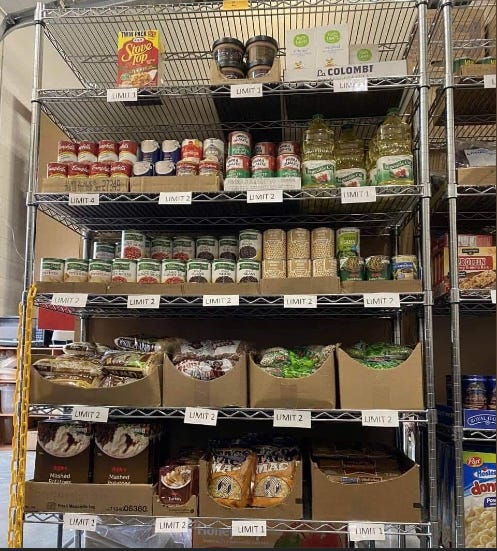
1. Everyone donates Kraft Mac and Cheese in the box. They can rarely use it because it needs milk and butter which is hard to get from regular food banks.
2. Boxed milk is a treasure, as kids need it for cereal which they also get a lot of.
3. Everyone donates pasta sauce and spaghetti noodles.
4. They cannot eat all the awesome canned veggies and soup unless you put a can opener in too or buy pop tops.
5. Oil is a luxury but needed for Rice a-Roni which they also get a lot of.
6. Spices or salt and pepper would be a real Christmas gift.
7. Tea bags and coffee make them feel like you care.
8. Sugar and flour are treats.
9. They fawn over fresh produce donated by farmers and grocery stores.
10. Seeds are cool in Spring and Summer because growing can be easy for some.
11. They rarely get fresh meat.
12. Tuna and crackers make a good lunch.
13. Hamburger Helper goes nowhere without ground beef.
14. They get lots of peanut butter and jelly but usually not sandwich bread.
15. Butter or margarine is nice too.
16. Eggs are a real commodity.
17. Cake mix and frosting makes it possible to make a child’s birthday cake.
18. Dishwashing detergent is very expensive and is always appreciated.
19. Feminine hygiene products are a luxury and women will cry over that.
20. Everyone loves Stove Top Stuffing.
Someone under one of my posts mentioned that Aldi is is selling a “Thanksgiving Feast” package that feeds 10 ppl for just $40. The items include:
• Whole Turkey
• Chicken Broth
• Condensed Cream of Mushroom Soup
• Evaporated Milk
• Hawaiian Sweet Rolls
• Miniature Marshmallows
• Cut Green Beans (x2)
• 100% Pure Canned Pumpkin
• Shells & Cheese (x2)
• Brown Gravy Mix (x3)
• Poultry Spices & Herbs
• French Fried Onions
• Pie Crust
• Chicken or Cornbread Stuffing (x2)
• Whipped Dairy Topping
• Yellow Onions (3 lbs.)
• Baby Peeled Carrots
• Celery
• Cranberries
• Sweet Potatoes (3 lbs.)
• Russet Potatoes (10 lbs.)
This may not be the perfect list, but it’s definitely a good one for $40. (Great, really!)
People fall on hard times for no fault of their own. People need help sometimes, everyone does, and it is not indicative of a moral failing or any other such accusation of being substandard human being. If anything, the fact that these attitudes exist are indication of how badly our hyper individualized isolationist society is failing us!
We need each other. And as inconvenient as the government shutting down and withholding benefits for those in need is, it is also giving us an opportunity to rise up and take care of each other.